 Benelog Tech Notes
You often hear that "in Java method calls, primitive types are passed by call by value and objects are passed by call by reference." Java, however, has only call by value. When you pass an object to a method, the value that gets copied is simply a reference that points to the object. This article lays out the definitions of the two terms and compares how Java, Kotlin, JavaScript, C, C++, C#, Python, Go, Rust, and Ada pass arguments.
Call by Value and Call by Reference
Call by value initializes a separate variable, the parameter, with the value passed as the argument. The value is usually copied, though some languages such as Rust move ownership instead. Assigning a different value to the parameter inside the function does not affect the caller’s variable.
Call by reference passes the variable itself. The parameter becomes an alias of the caller’s variable, so assigning a new value to the parameter inside the function also changes the caller’s variable.
These definitions follow the standard treatment in programming language theory.
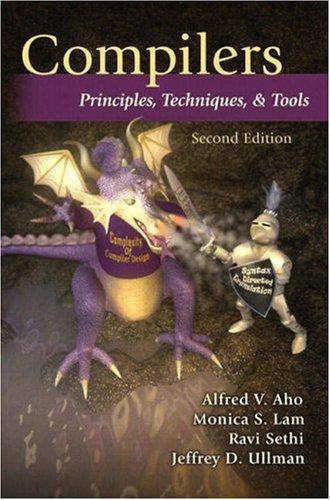
Section 1.6.6 of Compilers: Principles, Techniques, and Tools, 2nd edition, describes the two mechanisms as follows.
In call-by-value, the actual parameter is evaluated (if it is an expression) or copied (if it is a variable). The value is placed in the location belonging to the corresponding formal parameter of the called procedure. This method is used in C and Java, and is a common option in C++, as well as in most other languages. …
In call-by-reference, the address of the actual parameter is passed to the callee as the value of the corresponding formal parameter. Uses of the formal parameter in the code of the callee are implemented by following this pointer to the location indicated by the caller. Changes to the formal parameter thus appear as changes to the actual parameter.
Compilers: Principles, Techniques, and Tools, 2nd edition, Section 1.6.6
The "actual parameter" in the quote corresponds to what this article calls an argument, and the "formal parameter" corresponds to what this article calls a parameter. Together with its 1977 predecessor Principles of Compiler Design, this book has served as the standard textbook for university compiler courses. Its cover illustration earned it the nickname "the Dragon Book."
Christopher Strachey explained the distinction in terms of L-values and R-values in Section 3.4.2 of Fundamental Concepts in Programming Languages, his 1967 lecture notes. He called passing the R-value of an expression to a parameter call by value, and passing its L-value call by reference.
When the function is used (or called or applied) we write f[ε] where ε can be an expression. If we are using a referentially transparent language all we require to know about the expression ε in order to evaluate f[ε] is its value. There are, however, two sorts of value, so we have to decide whether to supply the R-value or the L-value of ε to the function f. Either is possible, so that it becomes a part of the definition of the function to specify for each of its bound variables (also called its formal parameters) whether it requires an R-value or an L-value. These alternatives will also be known as calling a parameter by value (R-value) or reference (L-value).
Fundamental Concepts in Programming Languages, Section 3.4.2
An L-value is the storage location denoted by an expression on the left side of an assignment, and an R-value is the value stored in that location, denoted by an expression on the right side. These lecture notes are a classic of programming language theory and are still cited as the origin of terms such as L-value, R-value, and first-class object.
A practical test for telling the two mechanisms apart fits in one sentence: When a function assigns a new value to its parameter, does the caller’s variable change? If it does, the mechanism is call by reference; if it does not, it is call by value. The test holds under the assumptions of this article: only these two mechanisms are compared, the argument is a reassignable variable, and the parameter can be assigned to. Once other evaluation strategies such as call by copy-restore and call by name come into play, this question alone cannot classify every argument-passing mechanism.
The assignment in this test means putting a different value into the parameter variable itself, as in targetTv = new Tv(). If the parameter points to an object, this makes it point to a different object. Changing the internal state of the object the parameter points to, as in targetTv.setChannel("Rock"), is a separate matter. The misconception discussed later comes from confusing the two.
The Terms "Pass by" and "Call by"
Call by value and call by reference are also called pass by value and pass by reference. The call by ~ form dates back to the ALGOL 60 report published in 1960. Section 4.7.3 of the revised report of 1963 specifies how parameters are passed, with 4.7.3.1 titled "Value assignment (call by value)" and 4.7.3.2 titled "Name replacement (call by name)." The pass by ~ form is also widely used in practice and in textbooks. This article uses call by ~ throughout.
Call by Sharing
The argument-passing behavior of Java, JavaScript, and Python, which shares an object rather than the caller’s variable itself, is sometimes called call by sharing. The term comes from the design document of CLU, a language created in the mid-1970s by a team led by Barbara Liskov. The object-argument behavior of Java, Kotlin, JavaScript, and Python and the passing of class instances in C#, all covered later, fall into this category. The term "call by object reference" used in the Python tutorial means the same thing. The same structure appears when you pass a map or a pointer in Go, or a pointer in C.
"Call by value" can mislead people into thinking the whole object is copied, and "call by reference" can mislead them into thinking that reassignment is reflected in the caller’s variable. Call by sharing is a good term for avoiding both misconceptions. Some sources use it, such as the MDN JavaScript documentation quoted later, but it has not become a standard term in textbooks or language specifications. This article therefore continues with only the two categories of call by value and call by reference.
Java
Result of the swap Method
The output of the following code shows how Java passes arguments.
public class ReferenceTest {
    public static void main(String[] args) {
        String x1 = "Hello";
        String y1 = "World";
        swap(x1, y1); // (1)
        System.out.println(x1); // Hello

        int x2 = 1;
        int y2 = 2;
        swap(x2, y2); // (2)
        System.out.println(x2); // 1
    }

    static void swap(Object x, Object y) {
        Object temp = x;
        x = y; // (3)
        y = temp;
    }

    static void swap(int x, int y) {
        int temp = x;
        x = y;
        y = temp;
    }
}-
Copies of the reference values held by
x1andy1are assigned to the parametersxandy. -
The int values are copied into the parameters of the
swap(int, int)overload. Without this overload, references to autoboxed Integer objects would be passed to theObjectparameters, with the same result. -
Assigning each other’s values to the parameters
xandyinside the method does not change the caller’sx1,y1,x2, ory2.
By the test defined above, Java behaves as call by value for both primitive types and objects.
Why Reassigning a Parameter Does Not Affect the Caller’s Variable
Let’s look more closely at passing an object as a method parameter.
class Tv {
    private String channel;

    void setChannel(String channel) { this.channel = channel; }
    String getChannel() { return channel; }
}

public class ReassignTest {
    public static void main(String[] args) {
        var myTv = new Tv();
        myTv.setChannel("Classic");

        reassign(myTv); // (1)
        System.out.println(myTv.getChannel()); // Classic
    }

    static void reassign(Tv targetTv) {
        targetTv = new Tv(); // (2)
        targetTv.setChannel("Rock");
    }
}-
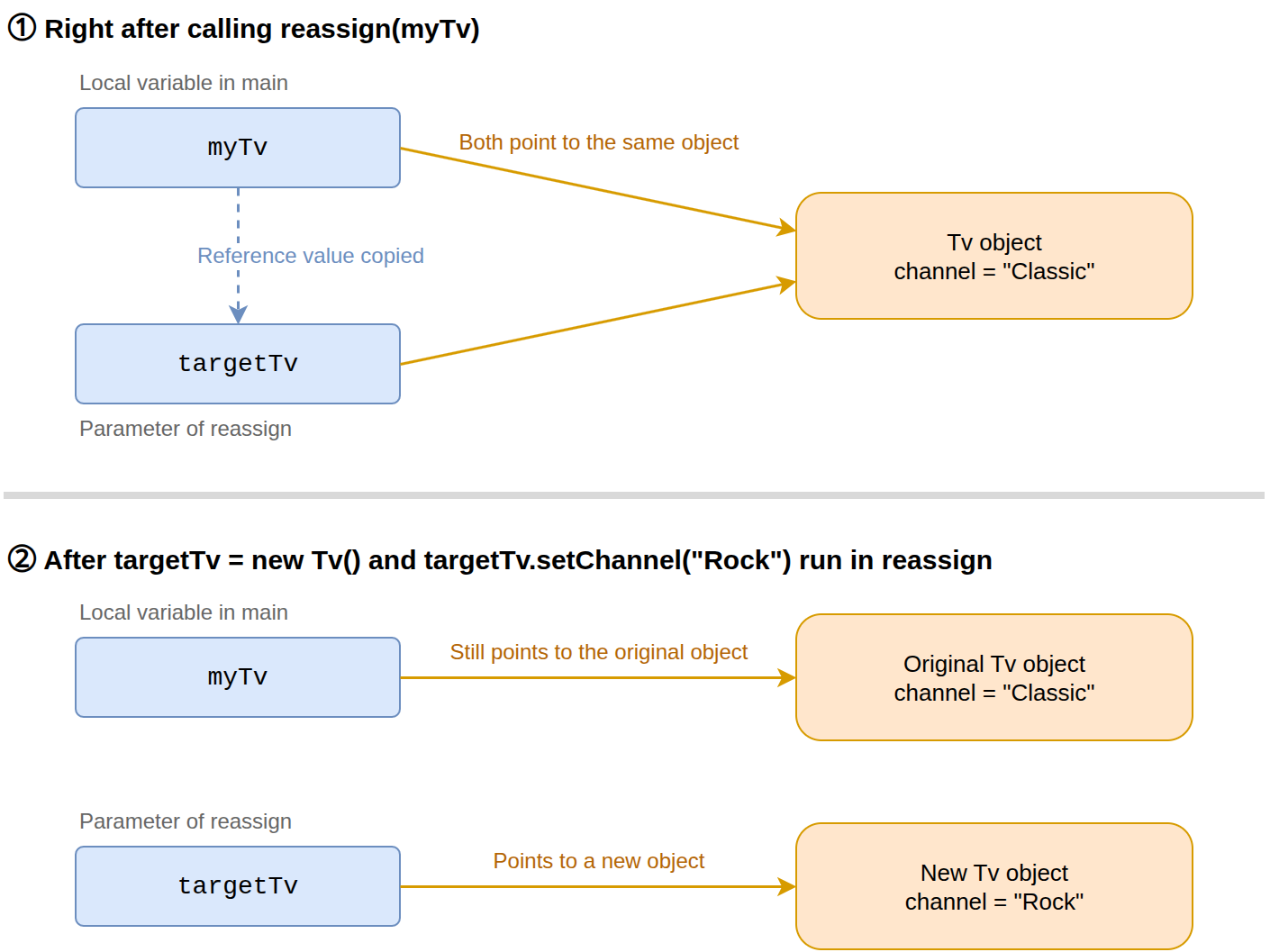
The reference value held by
myTvin the main method is copied and assigned to the parametertargetTvof the reassign method. The two variables point to the same object, but they are different variables. -
A new object is assigned to the parameter
targetTv. Only the parametertargetTvnow points to the new object, andmyTvin the main method still points to the original object. That is why the output isClassic.
Mutating Object State: The Source of the Misconception
If you change the internal state of the object the parameter points to, instead of reassigning the parameter, the changed state is visible through the caller’s variable.
public class ChangeStateTest {
    public static void main(String[] args) {
        var myTv = new Tv();
        myTv.setChannel("Classic");

        changeState(myTv); // (1)
        System.out.println(myTv.getChannel()); // (3)
    }

    static void changeState(Tv targetTv) {
        targetTv.setChannel("Rock"); // (2)
    }
}-
As in the previous example, the reference value held by
myTvis copied and assigned to the parametertargetTvof the changeState method. The two variables point to the same object. -
Without reassigning the parameter
targetTv, the method changes the channel of the object the parameter points toRock. This is the very object thatmyTvin the main method points to. -
Reading the channel through
myTvin the main method printsRock. The variable did not change, but the state of the object it points to did.
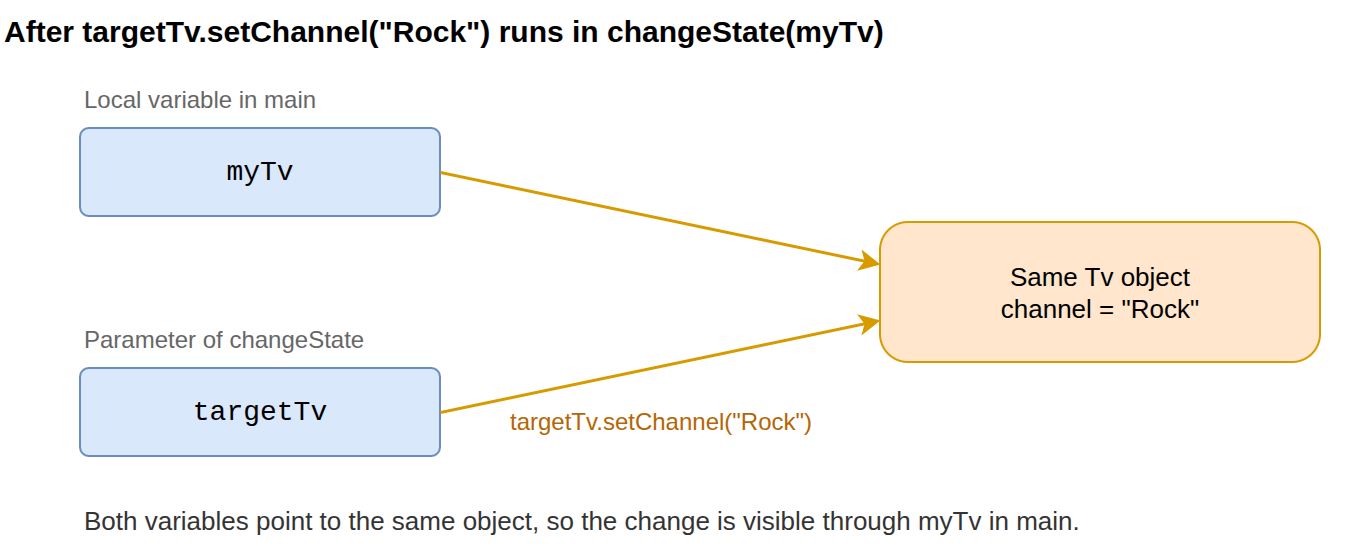
Because the changed state is visible through the caller’s variable, the claim that "objects are passed by call by reference" sounds plausible. As explained above, however, the practical test for the two mechanisms is whether a value assigned to the parameter is reflected in the caller’s variable. The changed state is visible through the caller’s variable only because both variables point to the same object, and what is passed is still a copy of the reference value. In other words, it is call by value.
Head First Java explains object references with the analogy of a TV remote control. Passing an object does not copy the TV (the object); it copies the remote control (the reference value) that operates the TV. If you change the channel with the copied remote (changing object state), the person holding the original remote sees the new channel too. If you pair the copied remote with a new TV (reassignment, targetTv = new Tv()), that remote can no longer operate the original TV, and the original remote is still paired with the original TV.
Java References and Terminology Confusion
James Gosling, the creator of Java, addressed this misconception directly in The Java Programming Language, which he coauthored.
Some people will say incorrectly that objects are passed "by reference." … The Java programming language does not pass objects by reference; it passes object references by value.
The Java Programming Language, 4th edition
Dev.java, the current official Java learning site, says the same thing.
Reference data type parameters, such as objects, are also passed into methods by value. … when the method returns, the passed-in reference still references the same object as before.
Calling Methods and Constructors
The Dragon Book quoted earlier also states in the same section that Java uses call by value exclusively. In the call-by-reference entry that follows, however, it writes that Java behaves as if it used call by reference for anything other than basic types.
Even though Java uses call-by-value exclusively, whenever we pass the name of an object to a called procedure, the value received by that procedure is in effect a pointer to the object. Thus, the called procedure is able to affect the value of the object itself. …
As we noted when discussing call-by-value, languages such as Java solve the problem of passing arrays, strings, or other objects by copying only a reference to those objects. The effect is that Java behaves as if it used call-by-reference for anything other than a basic type such as an integer or real.
Compilers: Principles, Techniques, and Tools, 2nd edition, Section 1.6.6
"Behaves as if it used call-by-reference" refers to the effect: the object is not copied as a whole, and changes the called method makes to the object’s state are visible to the caller. The phrase assumes what the book stated earlier, that the actual mechanism is not call by reference.
The word "reference" itself seems to have fed the misconception that Java passes objects by call by reference. Java calls a value that points to an object a "reference," and that word overlaps with the "reference" in "call by reference." Put more precisely, Java passes the reference value that points to an object by call by value.
A Java reference is a value that identifies and gives access to an object. You can think of it as a pointer. The following Java object access
var myTv = new Tv();
myTv.setChannel("Rock");
is similar to this C++ code that uses a pointer.
Tv *myTv = new Tv();
myTv->setChannel("Rock");
The Java variable myTv holds not the object itself but a value that points to the object. When you pass myTv as an argument to another method, this reference value is copied and passed. The C++ code above is an analogy for object access and pointer reassignment only; it does not mean that object lifetime management or the actual representation of references are the same.
Let’s look at the relevant wording in the JLS (Java Language Specification). The JLS also uses the word "pointer." Section 4.3.1. Objects defines reference values as pointers to objects.
The reference values (often just references) are pointers to these objects, and a special null reference, which refers to no object.
4.3.1. Objects
This describes language-level semantics; it does not guarantee that a reference value has the same format as a raw memory address. JVMS (Java Virtual Machine Specification) 2.7 does not mandate any particular internal structure for objects, and notes that in some implementations a reference may point to a handle rather than to the object data. A handle here is a small intermediate structure between the reference and the object data. The reference points to the handle, and pointers inside the handle in turn point to the object data and the method table. In other words, a reference value may not be the memory address where the object resides.
This description of handles originally described "Sun’s current implementation" in the first edition of the JVMS (1997). The second edition changed the wording to "some of Sun’s implementations," and editions after the Oracle acquisition to "some of Oracle’s implementations," but the content stayed the same. At the time of the first edition, Sun’s JVM was the Classic VM of JDK 1.0 and 1.1, and the "Handleless Objects" section of The Java HotSpot Performance Engine Architecture explains that the Classic VM used indirect handles. According to the same section, HotSpot, which today’s Oracle JDK and OpenJDK share, does not use handles and implements object references as direct pointers to objects.
How arguments are passed in a method call is described in Section 8.4.1. Formal Parameters. It says only that the "values" of the argument expressions initialize newly created parameter variables. Nothing in it says that a parameter becomes an alias of the caller’s variable, as call by reference was defined above.
When the method or constructor is invoked (§15.12), the values of the actual argument expressions initialize newly created parameter variables, each of the declared type, before execution of the body of the method or constructor.
8.4.1. Formal Parameters
A New Frame for Every Method Invocation
The JLS also describes, step by step, how a method invocation is executed. Section 15.12.4.5. Create Frame, Synchronize, Transfer Control says that once the method to invoke has been determined, a new activation frame is created and the argument values are placed in it. An activation frame is a region of memory that holds the execution state of a method call, such as its parameters, local variables, and return address, and that disappears when the call ends.
Now a new activation frame is created, containing the target reference (if any) and the argument values (if any), as well as enough space for the local variables and stack for the method to be invoked … The effect of this is to assign the argument values to corresponding freshly created parameter variables of the method, and to make the target reference available as this, if there is a target reference.
15.12.4.5. Create Frame, Synchronize, Transfer Control
The argument "values" are assigned to parameter variables freshly created in the new frame, not to the caller’s variables. This reaches the same conclusion as Section 8.4.1. The reference to the object on which an instance method is invoked (the target reference) is placed in the new frame in the same way and becomes this.
The JVMS defines this frame at the virtual machine level. Section 2.6. Frames says that a new frame is created on the thread’s JVM stack every time a method is invoked, and that each frame has its own array of local variables.
A new frame is created each time a method is invoked. … Frames are allocated from the Java Virtual Machine stack (§2.5.2) of the thread creating the frame. Each frame has its own array of local variables (§2.6.1), …
2.6. Frames
Parameters are passed through this local variable array, as Section 2.6.1. Local Variables explains.
The Java Virtual Machine uses local variables to pass parameters on method invocation. On class method invocation, any parameters are passed in consecutive local variables starting from local variable 0. On instance method invocation, local variable 0 is always used to pass a reference to the object on which the instance method is being invoked (this in the Java programming language). Any parameters are subsequently passed in consecutive local variables starting from local variable 1.
2.6.1. Local Variables
Let’s trace how the reference value of myTv in the earlier reassign example is copied into the parameter targetTv within this structure. Two concepts are needed first.
-
Operand stack: a last-in, first-out stack, one per frame, that serves as the workspace where JVM instructions pop operands and push results. It is also used to prepare the arguments passed to a method.
-
Bytecode: the JVM instructions that javac compiles Java source into and stores in class files. Two instructions appear in this example’s call sequence.
-
aload_1: pushes the reference value held in local variable 1 of the current frame onto the operand stack. -
invokestatic: invokes a static method. It pops the argument values from the operand stack, creates a new frame, and stores those values in the new frame’s local variables starting from local variable 0.
-
With these concepts, the call to reassign looks like the figure below. Because reassign is a static method, the parameter targetTv is local variable 0 of the reassign frame. The reference value held by myTv, which javac assigned to local variable 1 of the main frame, is copied into this slot. The JVMS dictates that parameters start at slot 0, but the compiler decides which slot each non-parameter local variable occupies. At the bytecode level, the aload_1 instruction pushes this reference value onto the operand stack of the main frame, and the invokestatic instruction pops it and stores it in local variable 0 of the new frame. The two slots are separate storage belonging to different frames, so assigning a new object to targetTv leaves myTv in the main frame pointing to the original object.
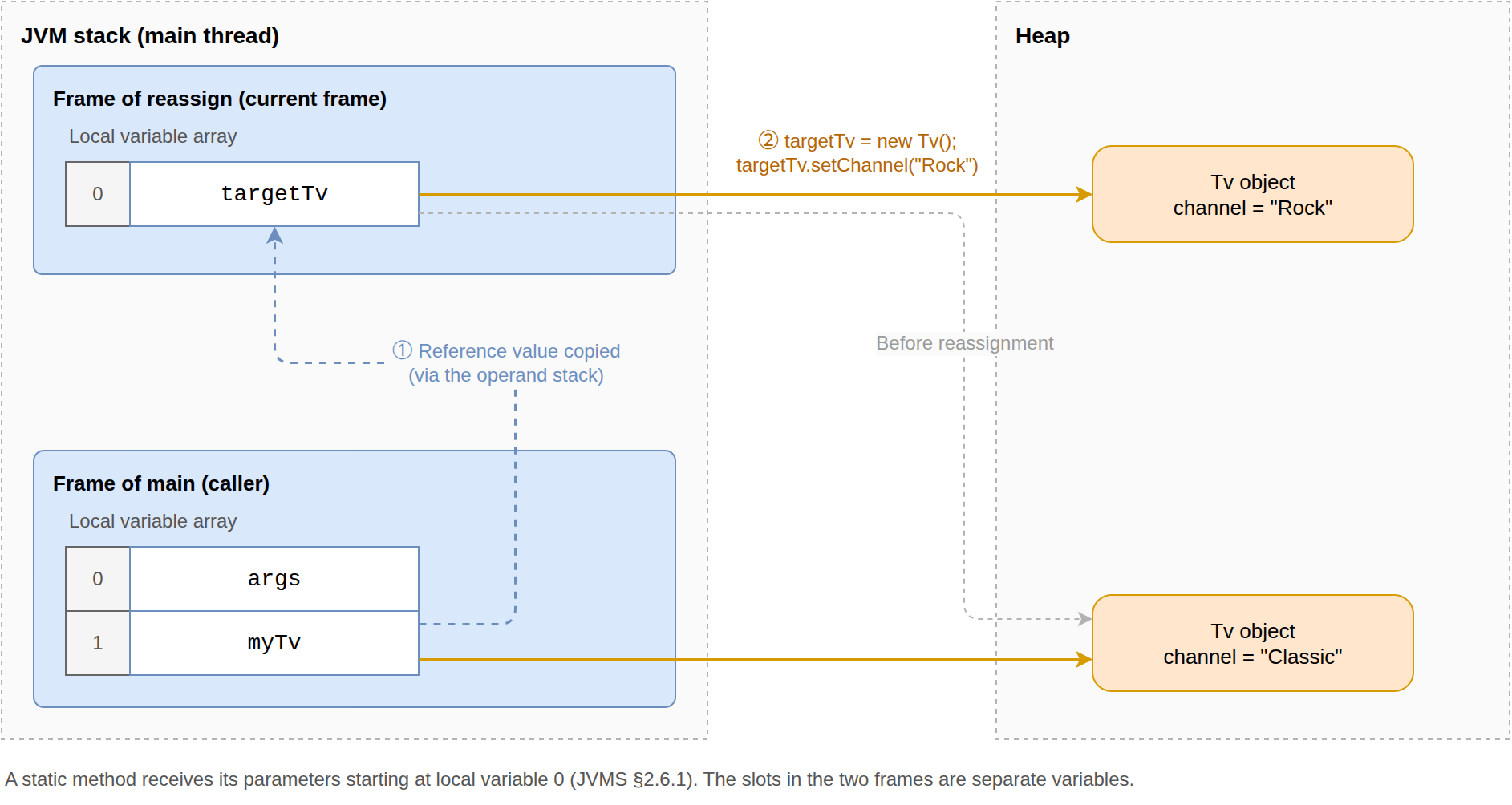
Keep in mind that the JVMS defines an abstract machine. It is a model that specifies the rules for how instructions behave, not the memory layout of a particular implementation. The introduction to Chapter 2 of the JVMS leaves the memory layout of run-time data areas to the implementor’s discretion. For example, machine code produced by a JIT compiler may keep parameters in CPU registers. Even so, the language semantics, in which the caller’s variable and the parameter are separate variables, do not change.
Kotlin
Kotlin does not support call by reference either. In Kotlin, however, you cannot even run this article’s test of whether assigning a new value to a parameter changes the caller’s variable. The Function declaration section of the Kotlin Language Specification states that each parameter is introduced as the name of a value inside the function body, so parameters are final and cannot be changed inside the function.
Each parameter pi: Pi = vi introduces pi as a name of value with type Pi available inside function body b; therefore, parameters are final and cannot be changed inside the function.
Function declaration
Code that assigns a new value to a parameter is a compile error.
class Tv(var channel: String)

fun main() {
    val myTv = Tv("Classic")
    changeState(myTv)
    println(myTv.channel) // Rock
}

fun reassign(targetTv: Tv) {
    targetTv = Tv("Rock") // (1)
}

fun changeState(targetTv: Tv) {
    targetTv.channel = "Rock" // (2)
}-
This is a compile error with the message "'val' cannot be reassigned."
-
Changing a property of the object the parameter points to makes the new value visible to the caller. If you delete the
reassignfunction that fails to compile and run the code, it printsRock.
Apart from reassignment being forbidden, Kotlin behaves like Java. On the JVM, what is passed is a copy of the reference value, as in Java. Because final parameters are part of the language specification, this does not change when you compile to non-JVM platforms such as Kotlin/JS or Kotlin/Native.
JavaScript
JavaScript behaves the same way as Java. Here is the swap example first.
function swap(x, y) {
  const temp = x;
  x = y;
  y = temp;
}

let x1 = "Hello";
let y1 = "World";
swap(x1, y1);
console.log(x1); // Hello
When an object is passed, reassigning the parameter or changing the object’s state inside the function also gives the same results as in Java.
const myTv = { channel: "Classic" };

reassign(myTv);
console.log(myTv.channel); // Classic

changeState(myTv);
console.log(myTv.channel); // Rock

function reassign(targetTv) {
  targetTv = { channel: "Rock" }; // (1)
}

function changeState(targetTv) {
  targetTv.channel = "Rock"; // (2)
}-
Assigning a new object to the parameter
targetTvdoes not change the caller’smyTv. -
Changing a property of the object the parameter points to makes the new value visible through the caller’s
myTv.
Replace the Tv object in the two Java figures above with an object literal, and they describe JavaScript’s behavior.
The Functions page on MDN summarizes this behavior in the same terms: arguments are always passed by value, and object arguments are, more precisely, passed by sharing.
Arguments are always passed by value and never passed by reference. This means that if a function reassigns a parameter, the value won’t change outside the function. More precisely, object arguments are passed by sharing, which means if the object’s properties are mutated, the change will impact the outside of the function.
Functions - Passing arguments
The ECMAScript specification also describes this behavior as initializing new parameter bindings with argument values, not as creating aliases of the caller’s variables. ArgumentListEvaluation obtains values from the argument expressions with GetValue and builds a list of ECMAScript language values, and FunctionDeclarationInstantiation initializes the parameter bindings of the new function environment from that list.
Unlike Java, the ECMAScript specification does not call the value used to access an object a "reference value." Object is one of the eight ECMAScript language types, the kinds of values a program manipulates directly, and an object itself is a value of that type. The "copied reference value" in this article is therefore best understood as a model for explaining the observed behavior.
TypeScript passes arguments the same way as JavaScript. The TypeScript Handbook states that, as a principle, TypeScript does not change the runtime behavior of JavaScript code.
As a principle, TypeScript never changes the runtime behavior of JavaScript code.
TypeScript for the New Programmer - Runtime Behavior
After type checking, the TypeScript compiler erases the type information and emits plain JavaScript, so argument passing is identical to the JavaScript behavior described above. TypeScript also has no syntax for reference parameters like C#'s ref and out, which are covered later.
The By Reference Wording in JavaScript: The Definitive Guide
Some sources make it easy to mistake JavaScript function calls for call by reference if you read only part of them. JavaScript: The Definitive Guide, 4th edition, written by David Flanagan and long regarded as the standard JavaScript book, has a summary table in Section 11.2, "By Value Versus by Reference," stating that objects are copied, passed, and compared by reference. From that table alone, it looks as if you could describe JavaScript as call by reference.
Read the explanation of the behavior in the same section, however, and the book’s "by reference" turns out to mean something different from the call by reference defined at the beginning of this article. The book uses the phrase to mean that a reference to the object is passed instead of the whole object value being copied, and it also explains that reassigning the parameter is not reflected in the caller’s variable.
A function can use the reference to modify properties of the object or elements of the array. But if the function overwrites the reference with a reference to a new object or array, that modification is not visible outside of the function. Readers familiar with the other meaning of this term may prefer to say that objects and arrays are passed by value, but the value that is passed is actually a reference rather than the object itself.
JavaScript: The Definitive Guide, 4th edition, 11.2 By Value Versus by Reference
The example that follows this explanation is titled "References themselves are passed by value." The observed behavior the book describes is the same as in this article; only the name for what is passed differs.
C
C has no syntax like C++ reference parameters, so it has only call by value. Paragraph 4 of 6.5.2.2 Function calls in the C11 working draft N1570 states that, in preparing a function call, the arguments are evaluated and each parameter is assigned the value of the corresponding argument.
In preparing for the call to a function, the arguments are evaluated, and each parameter is assigned the value of the corresponding argument.
6.5.2.2 Function calls, paragraph 4
Footnote 93, attached to the same paragraph, explains that a function may change the values of its parameters, but these changes cannot affect the values of the arguments; on the other hand, it is possible to pass a pointer to an object, and the function may then change the value of the object pointed to.
void swap(int* x, int* y) {
    int temp = *x;
    *x = *y; // (1)
    *y = temp;
}

int a = 1;
int b = 2;
swap(&a, &b); // (2)-
Writing to the variable the pointer points to changes the caller’s
a. Assigning a different address tox, however, leaves the caller’saunchanged. -
&is just the address-of operator, and copies of the pointer values are assigned to the parametersxandy. After the call,ais 2 andbis 1.
Applying the test from above, assigning a new value to a pointer parameter does not change the caller’s variable, so this is call by value. It has the same structure as Java passing a reference value to an object.
C++
C++ provides reference parameters, which are call by reference as this article defines it.
void swap(int& x, int& y) { // (1)
    int temp = x;
    x = y; // (2)
    y = temp;
}

int a = 1;
int b = 2;
swap(a, b); // (3)-
Declaring the parameter with type
int&makesxan alias of the caller’s variablea. -
An assignment inside the function actually changes the caller’s variable.
-
Unlike C’s
swap(&a, &b), nothing at the call site indicates that an address is passed. After the call,ais 2 andbis 1.
Pointer Parameters vs. Reference Parameters
C++ also has the pointer parameters (for example, int*) inherited from C, so the two need to be distinguished. Pointer parameters are call by value in C++ too. A function that takes pointers, such as void swap(int* x, int* y), receives copies of the pointer values in its parameters, exactly as in the C example. Assigning a different address to x inside the function is not reflected in the caller’s variable.
An int& reference parameter, on the other hand, has no syntax for reseating it at all. x = y; is not a statement that rebinds the reference to another variable; it assigns a value to the object the reference refers to. Applying the test from above to the two cases gives different results. Assigning to a pointer parameter (int*) leaves the caller’s variable unchanged, while assigning to a reference parameter (int&) changes it.
References in the C++ Standard
The C++ standard also describes a reference as an alias, not as a value that is passed. A note in [dcl.ref] says that a reference can be thought of as "a name of an object." Paragraph 4 of the same section explicitly leaves unspecified whether a reference requires storage.
It is unspecified whether or not a reference requires storage ([basic.stc]).
[dcl.ref] paragraph 4
Even though compilers usually implement references as addresses, the standard does not even specify whether a reference has storage.
If you judge by what is copied at the machine level, no language would have call by reference at all. The two terms distinguish the semantics a language defines, not the compiled result.
That said, the C++ standard does not call reference parameters call by reference. Searching the entire standard turns up no occurrence of "call by value," "call by reference," or "pass by value," and only four occurrences of "passed by reference," all in notes or library clauses rather than normative definitions. Instead of naming evaluation strategies, the standard specifies behavior. Paragraph 6 of [expr.call] says only that each parameter is initialized with its corresponding argument.
When a function is called, each parameter ([dcl.fct]) is initialized ([dcl.init], [class.copy.ctor]) with its corresponding argument.
[expr.call] paragraph 6
How a parameter of reference type is initialized is governed separately by the reference binding rules. Call by value and call by reference are not standard terms of any particular language; they are programming language theory terms for comparing argument-passing mechanisms across languages.
C#
Like C++, C# supports call by reference in its syntax. The Method parameters page of the C# reference states that C# passes arguments by value by default, and that a method receives a copy of the value for value types such as structs and a copy of the reference for reference types such as classes.
By default, C# passes arguments to functions by value. This approach passes a copy of the variable to the method. For value (struct) types, the method gets a copy of the value. For reference (class) types, the method gets a copy of the reference.
Method parameters and modifiers
The page goes on to explain that when a reference type is passed by value, reassigning the parameter inside the method does not change the caller’s variable, while changing an instance member is visible through the caller’s variable because both variables refer to the same instance. So far, this is the same as Java.
To pass a parameter by reference, you add the ref, out, in, or ref readonly modifier. Of these, only ref and out allow assigning to the caller’s variable. The same page explains that a parameter passed by reference has no value of its own; it is a reference variable that refers to another variable, the referent. This is call by reference as defined in this article: the parameter becomes an alias of the caller’s variable.
void Swap(ref int x, ref int y) // (1)
{
    int temp = x;
    x = y; // (2)
    y = temp;
}

int a = 1;
int b = 2;
Swap(ref a, ref b); // (3)-
The parameter
x, declared with therefmodifier, becomes an alias of the caller’s variablea. -
Assigning to the parameter changes the caller’s variable.
-
Unlike C++, the call site also needs
ref. After the call,ais 2 andbis 1.
Because a ref parameter requires ref at both the method declaration and the call site, you can tell from the call expression alone that the caller’s variable may change, unlike with C++ reference parameters. out is a variant in which the caller passes an uninitialized variable and the method must assign a value to it, and in and ref readonly are read-only references that the method cannot modify.
ref also works with variables of reference types. Passing a class instance as is copies the reference, as in Java, so reassigning the parameter is not reflected in the caller’s variable. Passing it with ref makes the parameter an alias of the caller’s variable, so reassignment can change which object the caller’s variable points to.
var myTv = new Tv();
myTv.Channel = "Classic";

Replace(ref myTv); // (1)
Console.WriteLine(myTv.Channel); // Rock

void Replace(ref Tv targetTv)
{
    targetTv = new Tv(); // (2)
    targetTv.Channel = "Rock";
}

class Tv
{
    public string Channel { get; set; } = "";
}-
If you declare it as
Replace(Tv targetTv)withoutrefand callReplace(myTv), it behaves like Java’sreassign(myTv)and printsClassic. If the declaration hasrefand you omit only therefat the call site, it is a compile error. -
Assigning a new object to the
refparameter makes the caller’smyTvpoint to the new object. Running it on .NET 8 printsRock.
C# distinguishes in its syntax between "passing a reference type by value" and "passing a variable by reference with ref," two different behaviors.
Python
Like Java, Python has only call by value. Section 4.8 Defining Functions of the official tutorial explains that arguments are introduced into the local symbol table of the called function, so they are passed using call by value, where the value is always an object reference.
The actual parameters (arguments) to a function call are introduced in the local symbol table of the called function when it is called; thus, arguments are passed using call by value (where the value is always an object reference, not the value of the object).
4.8 Defining Functions
A footnote on this sentence adds that "call by object reference" would be a better description, because when a mutable object is passed, the caller sees any changes made to it. The Python FAQ answers more directly: arguments are passed by assignment, and since assignment just creates references to objects, there is no alias between an argument name in the caller and in the callee, and so no call by reference.
def swap(x, y):
    x, y = y, x  # (1)

a, b = 1, 2
swap(a, b)
print(a)  # 1


class Tv:
    def __init__(self, channel):
        self.channel = channel


def main():
    my_tv = Tv("Classic")
    reassign(my_tv)
    print(my_tv.channel)  # Classic
    changeState(my_tv)
    print(my_tv.channel)  # Rock


def reassign(targetTv):
    targetTv = Tv("Rock")  # (2)


def changeState(targetTv):
    targetTv.channel = "Rock"  # (3)


main()-
This only rebinds the local names
xandyto different objects, so the caller’sastays 1. -
Rebinding the parameter
targetTvto a new object leaves the caller’smy_tvunchanged, andClassicis printed. -
Changing an attribute of the object
targetTvpoints to makes the change visible through the caller’smy_tv, andRockis printed.
The results are the same as Java’s Tv example and JavaScript’s reassign and changeState examples.
Because the caller’s variable stays the same when you pass an integer or a string, but appears changed when you pass a list or a dictionary, it is easy to assume the passing rule depends on the type. The rule is the same. Integers and strings are immutable objects, so there is simply no way to change their internal state. Even with a list, rebinding the parameter inside the function, as in x = [1], leaves the caller unchanged.
Go
Go does not make the caller’s variable an implicit alias of a parameter in a function call either. The Calls section of the Go specification says that after the function value and arguments are evaluated, new storage is allocated for the function’s variables, including its parameters and results, and the arguments are assigned to the corresponding parameters. The Go FAQ answers more directly.
As in all languages in the C family, everything in Go is passed by value. That is, a function always gets a copy of the thing being passed, as if there were an assignment statement assigning the value to the parameter.
When are function parameters passed by value?
Taken literally, "all languages in the C family" is not accurate. C++ and C#, covered in this article, belong to the C family but support reference parameters in their syntax. Both languages still pass by value by default, though, and passing by reference is an exception that requires a modifier. The sentence is best read as "the default in C-family languages is pass by value, and Go has only that default." As in C, Go requires you to pass a pointer explicitly to change the caller’s variable.
func swap(x, y *int) {
    *x, *y = *y, *x // (1)
}

a, b := 1, 2
swap(&a, &b) // (2)-
Writing to the variables the pointers point to changes the caller’s
aandb. Assigning a different pointer toxinside the function does not change the caller’sa. -
To change the caller’s values with an ordinary function, you pass pointers as in C. Copies of the pointer values are assigned to the parameters
xandy. After the call,ais 2 andbis 1.
Method calls, however, do not need & at the call site. The Calls section of the Go specification states that if x is addressable and the method set of &x contains m, then x.m() is shorthand for (&x).m(). For methods with pointer receivers, the compiler takes the address for you under this rule, so you cannot tell from the shape of the call expression alone whether the caller’s variable may change. Even then, what is passed is a pointer value.
Rust
Rust does not support call by reference in the sense defined in this article, a mechanism in which the parameter becomes an alias of the caller’s variable. Rust by Example calls passing a &T "passed by reference." A function call, however, does not create an alias of the caller’s variable, and a reference such as &mut T is itself a value that is passed by call by value. The Rust Book explains that passing a variable to a function moves or copies the value, just as assignment does.
Passing a variable to a function will move or copy, just as assignment does.
4.1 What is Ownership? - Ownership and Functions
To understand "move" in this explanation, you need Rust’s concept of ownership. The Ownership Rules section of the Rust Book summarizes ownership in three rules: each value has a variable that is its owner, there can be only one owner at a time, and when the owner goes out of scope, the value is dropped. An assignment such as let s2 = s1; transfers ownership to s2, which is called a move, and using s1 after the move is a compile error.
Which types are copied is determined by the Copy trait.
A trait declares behavior shared by multiple types, similar to an interface in other languages. Some traits have no methods and only tell the compiler about a property of the type; Copy is one of them.
Copy is a trait for types whose original variable remains usable after its value is assigned to another variable. The Stack-Only Data: Copy section of the Rust Book explains that variables of types implementing Copy are not moved but trivially copied, so they remain valid after assignment to another variable. Integers, floating-point numbers, bool, char, and tuples containing only Copy types belong to this group. Types that allocate heap memory or own resources, such as String and Vec, cannot be Copy, and adding Copy to a type that implements Drop, which performs cleanup when a value goes out of scope, is a compile error. In effect, only types that are safe to duplicate bit for bit can be Copy. So in let t = s;, if s is an i32 you can keep using s afterward, but if it is a String it is moved, as shown above.
A value of a non-Copy type such as String has its ownership moved into the parameter, and a value of a Copy type such as i32 is copied. When you pass a variable of type &mut T to a parameter of type &mut T, however, the compiler implicitly reborrows it, so you can use the variable again after the call even though &mut T is not Copy.
From this article’s perspective, moving and copying are the same mechanism, in which the parameter is initialized with the argument value, and neither creates an alias of the caller’s variable. The only difference is whether the caller’s variable remains usable after the call.
fn swap(x: &mut i32, y: &mut i32) { // (1)
    let temp = *x;
    *x = *y; // (2)
    *y = temp;
}

let mut a = 1;
let mut b = 2;
swap(&mut a, &mut b); // (3)-
What is passed to the parameter
xis a value of type&mut i32. -
Writing to the variable the mutable reference points to changes the caller’s
a. -
To change the caller’s values with an ordinary function, you pass mutable references like this. After the call,
ais 2 andbis 1.
The standard library function std::mem::swap uses the same approach with the signature fn swap<T>(x: &mut T, y: &mut T). Passing mutable references is still not call by reference as defined in this article, in which reassigning the parameter itself changes the caller’s variable binding. To reassign x, you have to declare the parameter as mut x: &mut i32, and even then the reassignment has no effect on the caller’s a.
Like Go’s pointer-receiver methods, method calls in Rust do not need &mut at the call site. Under the method call rules in the Rust Reference, writing v.push(1) makes the compiler automatically borrow the receiver and pass &mut v, and what is passed is still a mutable reference value.
Ada: Call by Reference vs. Copy-Restore
The definitions section noted that the test "when a function assigns a new value to its parameter, does the caller’s variable change?" cannot classify every passing mechanism by itself. Ada is an example. Ada declares parameters with the modes in, in out, and out, and a value assigned to an in out or out parameter is reflected in the caller’s variable. Judged only by the result the caller observes, this is the same as C++ reference parameters.
Ada Reference Manual 6.2, however, decides whether a parameter is passed by copy or by reference mainly by its type, not its mode. Elementary types such as Integer are by-copy types and are passed by copy; by-reference types such as tagged types are passed by reference; and a formal parameter declared aliased is passed by reference regardless of its type. For parameters that fall into neither category, the manual does not specify whether they are passed by copy or by reference and leaves the choice to the implementation. For in out and out parameters passed by copy, 6.4.1 specifies that their values are copied back to the actual arguments when the subprogram completes normally. This is the call by copy-restore mentioned in the definitions section. The result, a changed caller variable, is the same as with call by reference, but the actual mechanism is copying.
The difference between passing by copy and passing by reference becomes visible when the procedure reads the variable passed as the actual argument directly. The example below passes the same variable Original to a procedure that receives it by copy and to one that receives it as aliased, and reads Original right after assigning to the parameter.
with Ada.Text_IO; use Ada.Text_IO;

procedure Demo is
   Original : aliased Integer := 1;

   procedure By_Copy (Param : in out Integer) is
   begin
      Param := 2;
      Put_Line ("inside By_Copy: Original =" & Integer'Image (Original)); -- (1)
   end By_Copy;

   procedure By_Reference (Param : aliased in out Integer) is
   begin
      Param := 2;
      Put_Line ("inside By_Reference: Original =" & Integer'Image (Original)); -- (3)
   end By_Reference;
begin
   By_Copy (Original);
   Put_Line ("after By_Copy: Original =" & Integer'Image (Original)); -- (2)

   Original := 1;
   By_Reference (Original);
   Put_Line ("after By_Reference: Original =" & Integer'Image (Original));
end Demo;-
Integeris a by-copy type, soParamis a copy ofOriginal. Right after 2 is assigned toParam,Originalis still 1. -
When the procedure completes normally, the value of
Paramis copied back toOriginal, andOriginalbecomes 2. -
An
aliasedparameter is passed by reference, soParamis an alias ofOriginal. The moment 2 is assigned toParam,Originalis 2 as well.
This is the output when compiled with GNAT 13.3, the Ada compiler included in GCC.
inside By_Copy: Original = 1
after By_Copy: Original = 2
inside By_Reference: Original = 2
after By_Reference: Original = 2
After both calls return, the value is 2 in both cases, but reading Original inside the procedures gives different results. A language supporting parameter modes in its syntax and those modes being implemented as call by reference are two separate facts.
Summary
The following table summarizes how the languages covered in this article pass arguments.
| Language | Supports call by reference | Passing mechanism | Changing the caller’s variable through a parameter |
|---|---|---|---|
Java |
No |
Call by value. For objects, a copy of the reference value is passed |
Not possible. Only object state changes are shared |
Kotlin |
No |
Call by value. Parameters are final, so reassignment is a compile error |
Not possible. Only object state changes are shared |
JavaScript |
No |
Call by value. The Object value is assigned to a separate parameter binding |
Not possible. Only object state changes are shared |
C |
No |
Call by value |
Pass a pointer ( |
C++ |
Yes, only for reference parameters ( |
Call by value by default. Only reference parameters are call by reference |
Declare a reference parameter. You can also pass a pointer as in C |
C# |
Yes, with |
Call by value by default. For class instances, a copy of the reference is passed |
Declare a |
Python |
No |
Call by value. The value is always an object reference |
Not possible. Only object state changes are shared |
Go |
No |
Call by value. Map and slice values behave like pointers |
Pass a pointer ( |
Rust |
No |
Call by value. Depending on the type, the value is moved or copied as in assignment, and a mutable reference |
Pass a mutable reference ( |
Ada |
Partially. By-reference types and parameters declared |
By copy or by reference, depending on the type |
Declare an |
-
Java, Kotlin, JavaScript, and Python initialize a separate parameter variable or binding with the argument value. They do not support call by reference, in which the caller’s variable itself becomes an alias of the parameter.
-
Passing an object neither clones the object nor passes the caller’s variable itself. In Java, the reference value that points to the object, and in JavaScript, the Object value, is passed to a separate parameter, and the caller and callee can observe the same object.
-
Reassigning a parameter inside a function does not change the caller’s variable. Changing the internal state of the object the parameter points to, on the other hand, is visible through the caller’s variable. This difference is the source of the misconception that "objects are call by reference."
-
-
C and Go pass pointers, and Rust passes mutable references, to change the caller’s values. A call that takes the address or reference of a variable on the spot shows
&or&mut, but when you pass a variable that already holds a pointer or reference, or when the compiler takes the address or borrows for you as in Go and Rust method calls, you cannot tell from the shape of the call expression alone. The only languages here in which a parameter becomes an alias of the caller’s variable are C++, C#, and Ada, and Ada sometimes passes by copy and copies back depending on the type. -
This object-sharing behavior is sometimes called call by sharing. Some sources, such as JavaScript: The Definitive Guide, 4th edition, describe object sharing as "by reference," but it should be distinguished from call by reference in the sense of passing an alias of the caller’s variable.
References
-
Terminology
-
Alfred V. Aho, Monica S. Lam, Ravi Sethi, Jeffrey D. Ullman, Compilers: Principles, Techniques, and Tools, 2nd edition, Addison-Wesley, 2007, 1.6.6 Parameter Passing Mechanisms
-
Christopher Strachey, Fundamental Concepts in Programming Languages, Higher-Order and Symbolic Computation, Vol. 13, 2000, 3.4.2 Parameter calling modes
-
Revised Report on the Algorithmic Language Algol 60 - 4.7.3 Semantics
-
-
Java
-
Java Language Specification - 15.12.4.5. Create Frame, Synchronize, Transfer Control
-
Java Virtual Machine Specification - 2.7. Representation of Objects
-
Java Virtual Machine Specification (Java SE 6) - 3.7 Representation of Objects
-
The Java HotSpot Performance Engine Architecture - Handleless Objects
-
Ken Arnold, James Gosling, David Holmes, The Java Programming Language, 4th edition, Addison-Wesley, 2006
-
Kathy Sierra, Bert Bates, Head First Java, 2nd edition, O’Reilly, 2005, Chapters 3 and 4
-
Kotlin
-
JavaScript
-
C
-
C++
-
C#
-
Python
-
Go
-
Rust
-
Ada
Twitter
Facebook
Reddit
LinkedIn
Email